Translate

Showing posts with label Ancient India. Show all posts

Friday, September 14, 2012

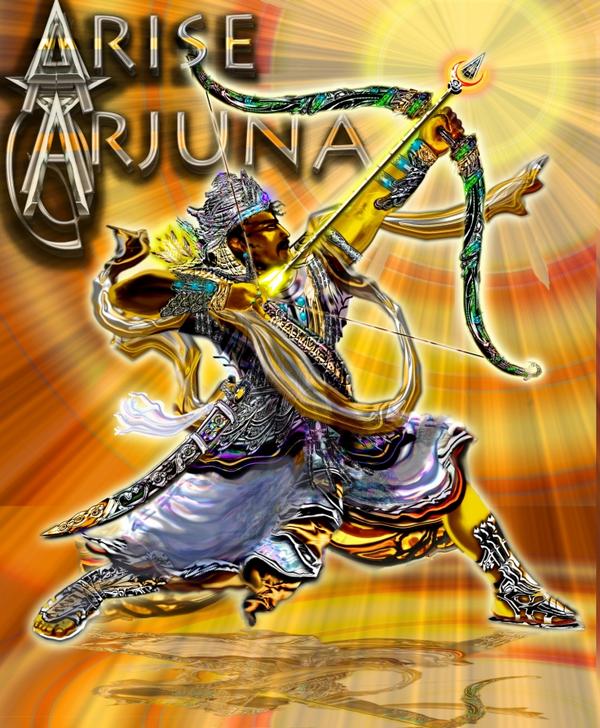
Arjuna the Warrior Prince


          He walked over to where the children were eating and placed a metal figurine of an ancient soldier with six arms on the table. The figure stood about a foot tall, and the arms were jointed and bendable. Two of the arms were holding an elaborate bow and arrow. Zammie noticed that the arms were moveable and were connected to a series of small gears that could be seen on the inside of the figure.
          “How does it work?” he asked.
          Ramesh pressed all six of Arjuna’s arms down to its side then twisted the figure at its waist. When he let go, the gears began to turn causing the arms to move around like tentacles.
          “Cool!” said Zammie. “You’re giving this to me?”
          “Sure. It’s supposed to help children learn about history,” said Ramesh. “It helped me do well in school when I was a boy. Maybe it will help you too.”
          “How does he help?” asked Zammie.
          “You just wind it up and let it run right before you do your homework, and then let Arjuna work his magic.”
          “Magic?” asked Kyla.
          Ramesh gave a small laugh, “Yes, magic. But you have to really concentrate when he’s moving. Look deep into his eyes, and when he’s done waving his arms you’ll be able to write even more wonderful papers about history.”
          “Thanks!” said Zammie. “Can I go try it out now?”
          “Of course, but be sure and share with Kyla too,” said Ramesh. “Maybe it will help her with her schoolwork as well.”
          “Let’s go, Kyla!” Zammie grabbed the little Arjuna and took off to his room. Kyla followed close behind.
          “You wanna do homework now, Zammie?” complained Kyla.


-- The Arjuna Statue

from Time Trip #1 (Chapter 1)


The short film above is a modern day Chitra Katha in animation that celebrates the intricate form of this historic hand printing craft, that was handed down from generation to generation, until it got lost somewhere in the advent of machine printing. Arjuna the Mythological Archer adorns this first ever handmade version of The Great Indian Yellow Pages, in a vivid story that simplifies online yellow pages and encourages online transactions through the life of Arjuna in 2008 AD.


Arjuna is one of the most celebrated human heroes in Hindu scripture. Wholesome, devoted and magnanimous, he bears many noble qualities of human beings. His theological significance is also immense. In his dialouge with Lord Krishna in the Bhagavadgita, wherein the nature of the universe is unraveled for him, Arjuna embodies the qualities of the ideal student. His willingness to accept the word of Krishna, even though it involves raising his weapons against his kinfolk, illustrates his ideal devotion to God. Together, the inseparable friendship between Krishna and Arjuna represent the cosmic inseparability of Brahmanand atman, or the essence of the universe and the soul, one of the fundamental ideas of Hinduism. In a more general sense of comparative myth, Arjuna also stands as the archetypal reluctant hero, who is called to a task of great import and initially shirks his duty, only to reconsider and perform his task with unmatched effectiveness. As such, Arjuna is a hero not only for Hindus but also for the entirety of humanity.


TIME TRIP ADVENTURE 4
KILLING FOR COUNTRY  
Available at Amazon.com!

TIME TRIP ADVENTURE 1
THE JOURNEY TO ANCIENT GREECE 
Available at Amazon.com!

TIME TRIP ADVENTURE 2
A RIDE ON THE UNDERGROUND RAILROAD
Available at Amazon.com!

TIME TRIP ADVENTURE 3
WITNESS TO THE FIRST THANKSGIVING 
Available at Amazon.com!  


Friday, July 27, 2012

Alexander the Great in India

Alexander the Great (356-323 BC)
After conquering the Achaemenid Empire of Persia, the Macedonian king (and now high king of the Persian Empire) Alexander the Great launched a campaign in north-western India. The rationale for this campaign is usually said to be Alexander's desire to conquer the entire known world, which the Greeks thought ended in north-western India.


"Phalanx attacking the centre
in the battle of the Hydaspes"
by Andre Castaigne (1898-1899)


Alexander crossed the Indus and fought and won an epic battle against King Porus, who ruled a region in the Punjab, in the Battle of the Hydaspes in 326 BC. Alexander was impressed by Porus's bravery, and made him an ally. He appointed Porus as satrap, and added to Porus' territory land that he did not previously own. Choosing a local helped him control these lands so distant from Greece. Alexander founded two cities on opposite sides of the Hydaspes river, naming one Bucephala, in honor of his horse, who died around this time. The other was Nicaea (Victory) located at the site of modern day Mong, Punjab.


In 321 BC, two years after Alexander's death, Chandragupta Maurya of Magadha, founded the Maurya Empire in India and took many Greeks and Greek satraps as slaves after defeating them in a rough battle.


Image from Revolution Magik


Time Trip Adventure 1 
The Journey to Ancient Greece 
PDF available FREE here 

TIME TRIP ADVENTURE 2
A RIDE ON THE UNDERGROUND RAILROAD
Available at Amazon.com! 


Wednesday, July 11, 2012

Ashoka the Great

As they approached the front gate to the Kaiaphas farm Argo was walking out ahead of Vinnie while Kyla and Zammie walked on either side of Vinnie and a few steps back. Both of the cousins held large palm leaves that they used to fan Vinnie with as if he was the Sultan of Arabia. They made quite a procession as they approached the watchman at the front gate.
“What do you want?” asked the watchman.
“Greetings, sir,” said Argo. “May I introduce to you the Maharaja Garuda. We are here seeking audience with Lord Kaiaphas, owner of this farm.”
The watchman couldn’t believe what he was hearing.
“Maha-what?” he asked. “Who are you people?”
“Just visitors to your wonderful land,” said Argo, “and we are politely requesting the presence of Lord Kaiaphas because we have some items for sale that we believe he will be very interested in seeing.”
“What kind of items?” asked the watchman.
“Magic items, sir, magic items, but that is all I am at liberty to say right now. If Lord Kaiaphas has no interest in these items then we will be on our way."
-- Introduction of the "Maharaja"
from Time Trip #1 (Chapter 13)


Actor Shah Rukh Khan from the film Aŝoka

Ashoka the Great ruled as a just and merciful king from his epiphany in 265 until his death in 232 BCE, at the age of 72. We no longer know the names of most of his wives and children, but his twin children by his first wife, Devi, a boy called Mahindra and a girl named Sanghamitra, were instrumental in converting Sri Lanka to Buddhism.

After Ashoka's death, the Mauryan Empire continued to exist for 50 years, but it went into a gradual decline. The last Mauryan emperor was Brhadrata, who was assassinated in 185 BCE by one of his generals, Pusyamitra Sunga. Although his family did not rule for long after he was gone, Ashoka's principles and his examples lived on through the Vedas. He is now known the world over as one of the best rulers ever to have reigned.
From AsianHistory.com

Kareena Kapoor as Kaurwaki from the film Aŝoka


TIME TRIP ADVENTURE 4
KILLING FOR COUNTRY  
Available at Amazon.com!

TIME TRIP ADVENTURE 1
THE JOURNEY TO ANCIENT GREECE 
Available at Amazon.com!

TIME TRIP ADVENTURE 2
A RIDE ON THE UNDERGROUND RAILROAD
Available at Amazon.com!

TIME TRIP ADVENTURE 3
WITNESS TO THE FIRST THANKSGIVING 
Available at Amazon.com!